The quietest system
is the cheapest to run.
Commercial refrigeration is often the single largest electricity line on a food business's utility bill. The right compressor, the right fan motor, a pair of closed doors, and a controller that knows when nothing needs to be cold — and the same operation can pay ten to forty per cent less every month. We look at what you have, tell you where the savings actually live, and walk you through which Ontario incentives apply. No cost, no pressure.
The promise
- Site assessment
- Free
- Written report
- Within 7 days
- Typical savings
- 20 – 40%
- Typical payback
- 18 – 36 months
Ranges are site-dependent. The assessment gives you site-specific numbers.
Six places
your bill leaks from.
Refrigeration savings are not magic. They come from six specific places, in roughly descending order of impact. An assessment tells you which of these apply to your site — and what the realistic payback is on fixing each one.
High-efficiency compressors
A compressor built a decade ago runs 20 – 35% harder than a modern, variable-capacity equivalent for the same cooling load. The largest single lever on most sites.
ECM fan motors & VFDs
Electronically commutated evaporator and condenser fan motors, with variable-frequency drives on larger loads, cut auxiliary energy by 30 – 60% versus shaded-pole motors.
Modern refrigeration controls
Electronic expansion valves, floating head pressure, demand-based defrost, and remote telemetry — all common on new installs, rare on equipment older than a decade.
Door seals & strip curtains
The least expensive fix on the list. A worn door gasket or missing strip curtain can represent 5 – 15% of runtime by itself. Often resolvable in a single service call.
LED cold-room lighting
Older fluorescent or incandescent lamps inside refrigerated space are heat sources the compressor has to remove. LED cuts lighting energy and refrigeration load at the same time.
Insulation & panel integrity
Damaged panels, compressed insulation, and poorly sealed refrigeration line penetrations let ambient heat leak in. Frequently overlooked in favour of the shinier compressor upgrade.
Ontario money on the table.
Rebate programs move every year. Rather than quote a number that could be stale tomorrow, here is the shape of what is usually available — and what we handle for you when you qualify.
Utility incentive programs
IESO / Save on Energy and utility-specific programs periodically offer prescriptive and custom incentives for efficient refrigeration, ECM motors, controls, and LED lighting. We check current eligibility before we quote.
Federal capital cost relief
Federal programs for clean and efficient equipment depreciation can improve after-tax ROI materially. Worth a conversation with your accountant — we provide the documentation the filing typically needs.
Refrigerant transition support
Older refrigerants (R-22, certain HFCs) are being phased out. Replacement with modern low-GWP refrigerants is sometimes subsidised and usually more efficient. Double win on operating cost and compliance.
Demand-response programs
Select peak-demand programs pay operators for curtailing non-critical load during grid-peak events. Modern refrigeration controls make participation painless — the cold rooms barely notice.
Program names, amounts, and eligibility criteria change. The assessment includes a current-year incentive review specific to your utility and equipment — we do the homework so you see a real number, not a webpage number.
Four steps. A written report you can act on.
Site visit
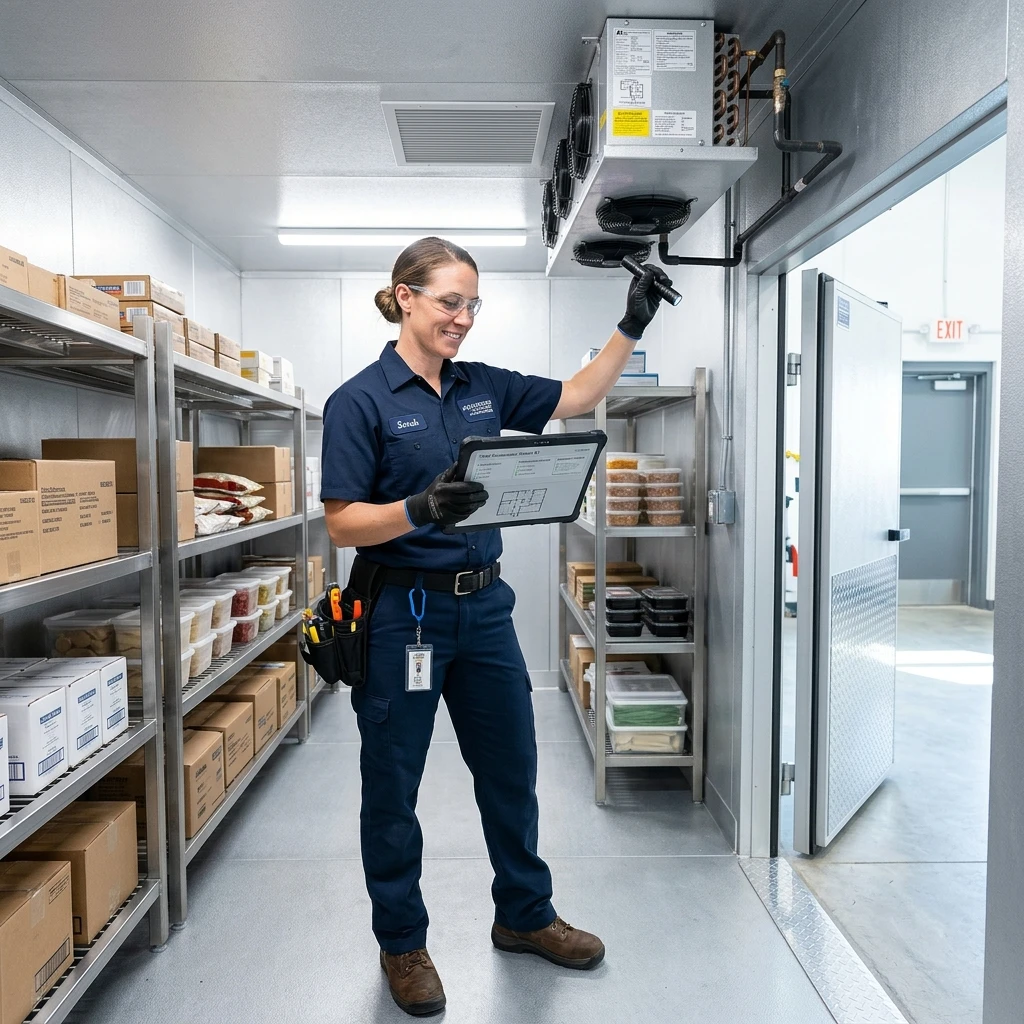
A technician walks the site — equipment nameplates, seal condition, insulation, controls, lighting, and how the room is actually used. Forty-five minutes to an hour for a typical restaurant or grocer.
Load & usage model
We build a realistic thermal-load model based on what is actually running: door traffic, product turnover, ambient temps, and the equipment you have. No vendor-optimistic fantasy numbers.
Utility bill benchmark
We review 12 months of utility bills where available. That grounds the estimate in your actual consumption pattern, not an industry average.
Written report
Inside 7 days, you get a written report: conservative savings range, recommended scope, current-year rebate eligibility, and a prioritised retrofit list. Yours to keep, no strings.
Conservative math, published in the open.
20 – 40% lower refrigeration runtime
Typical retrofit combining compressor, controls, ECM fans, and door integrity. On a $5,000-a-month site, that is $12,000 – $24,000 a year — before incentives.
18 – 36 month payback
Comprehensive retrofit payback, conservatively estimated, including incentive capture where available. Simple door and seal fixes pay back inside a quarter.
Lower refrigerant footprint
Modern low-GWP refrigerants, smaller charges, better leak detection. Useful for ESG reporting if you report, and for avoiding phase-out surprises if you do not.
Fewer service calls
New equipment with remote telemetry drops emergency call frequency sharply. The best savings are the ones that never show up on the repair invoice.
The honest answers.
Is the assessment really free?
Yes. The site visit and the written report are free, regardless of whether you hire us for the retrofit. We would rather spend an hour and lose the job than produce a number you cannot trust.
Do you handle the rebate paperwork?
For most current Ontario programs, yes. We provide the equipment documentation, nameplate data, and installation records that the incentive application typically requires. For more complex custom programs, we can coordinate directly with the utility program officer on your behalf.
What numbers should I bring to the site visit?
12 months of utility bills if you can pull them, a rough equipment age estimate, and any existing service history. If any of that is hard to find, tell us — we can work with what we see at the site.
Do you do this for new builds too?
Yes. For new-build projects, the assessment becomes part of the design review — we specify the envelope, equipment, and controls to hit your target operating cost before the first panel is ordered. Much cheaper to get it right on paper than to retrofit later.
What if the math does not pencil?
Then the report says so, and we tell you to wait. Not every site should retrofit today. Some are better served by a small door-and-seal intervention and a reassessment in 18 months when a major component reaches end of life. Honest answers beat good-looking quotes.
How old does my equipment need to be to benefit?
Equipment older than 10 years is almost always a candidate for something. Equipment 15+ years old is a near-certainty. But even recent installs sometimes have easy wins — mis-sized components, wrong refrigerant charge, or control settings that were never tuned for the actual usage pattern.
Let us look at your site.
No cost, no pressure. A site visit within a week, a written report inside seven days of that visit. We will tell you where your bill is leaking and which Ontario incentives apply this year.
Information is used only to scope the assessment and prepare the incentive review. Never shared beyond that.
Cold is failing?
We are already on the way.
Product losing temperature. Compressor down. Walk-in warming. Call the line — a technician answers, an ETA is given, and a van is moving. Under sixty minutes is the standard across the GTA.